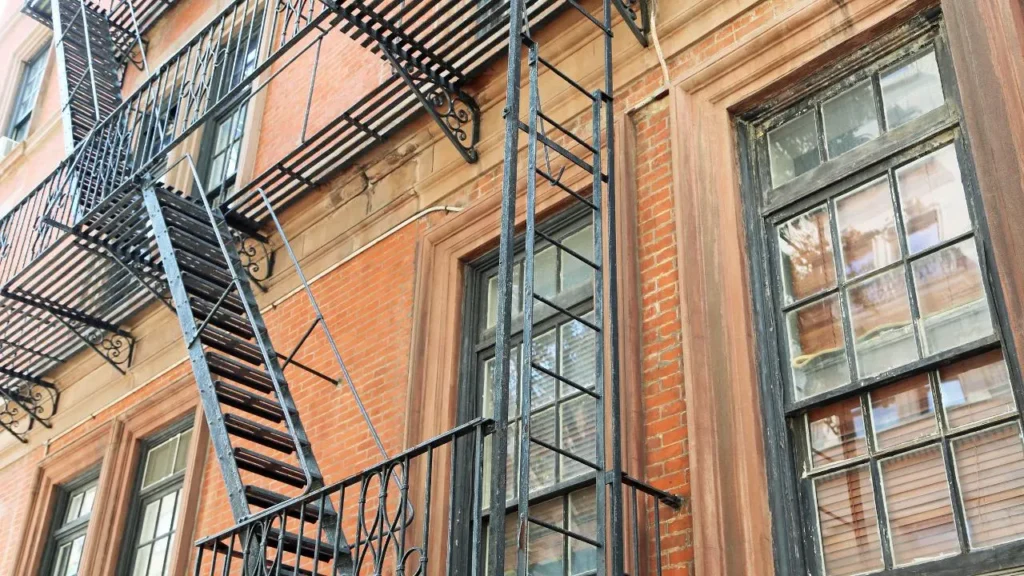
Fire safety in Australian buildings is regulated by the Australian Building Codes Board and the National Construction Code (NCC), alongside Standards Australia rules like AS 1657:2018. These set requirements for fire escape stairs, fire exit stairs, and emergency escape stairs. This guide is for Australian building managers, architects, developers, and compliance officers, offering insights on materials, installation, and maintenance to ensure safe, NCC-compliant fire stairs across Australian buildings.
What Are Fire Escape Stairs?
Fire escape stairs are purpose-built stair systems that provide a safe and continuous means of egress during emergencies such as fire. Under the NCC, they form part of a building’s essential exit system, enabling occupants to evacuate quickly and safely.
They differ from standard staircases in several key ways:
- They are constructed to meet specific fire-resistance and structural integrity criteria.
- They must comply with dimensional requirements such as riser height, tread depth, and landing spacing.
- They are integrated with fire doors, signage, lighting, and exit pathways.
In practical terms, emergency escape stairs are not optional features. They are mandatory life-safety infrastructure for most commercial, industrial, and multi-residential buildings in Australia.
Types of Fire Escape Stairs
Exterior Fire Escape Stairs
Exterior fire escape stairs are commonly used in:
- Warehouses
- Industrial facilities
- Multi-storey commercial buildings
- Retrofit projects
They are typically fabricated as steel fire escape stairs or other metal fire escape stairs, often galvanised or powder-coated for corrosion resistance. According to Safe Work Australia, access systems exposed to outdoor environments must address slip resistance and environmental durability.
Advantages:
- Reduced internal footprint
- Easier retrofitting to existing buildings
- Lower construction disruption
Limitations:
- Exposure to weather
- Higher long-term maintenance if coatings degrade
Interior Fire Stairs
Interior stairs are enclosed within fire-rated walls and often constructed in reinforced concrete or structural steel. They are common in high-rise and mixed-use developments.
The Australian Building Codes Board stairway provisions outline minimum widths, landing dimensions, headroom clearance, and handrail requirements depending on building classification.
Interior systems typically provide:
- Enhanced smoke protection
- Fire-isolated passageways
- Controlled evacuation flow
Commercial vs Residential Fire Escape Stairs
Commercial fire escape stairs generally face stricter requirements due to higher occupant loads and varied mobility needs. Warehouses, offices, and retail buildings must consider:
- Egress capacity calculations
- Exit travel distance limits
- Integration with sprinkler and alarm systems
Residential multi-storey buildings must also comply, but occupant load assumptions and layout constraints differ.
Materials and Construction Standards
Material selection directly affects durability, maintenance, and compliance with the Australian fire escape stairs standards.
Steel and Metal
Steel fire escape stairs are widely used in Australia because they offer:
- High load-bearing capacity
- Fire resistance when properly rated
- Prefabrication flexibility
Galvanised and coated metal fire escape stairs provide corrosion protection, which is critical in coastal and industrial zones.
AS 1657:2018, published by Standards Australia, specifies performance requirements for fixed platforms, walkways, stairways, and ladders, including:
Slip resistance
Guardrail dimensions
Structural integrity
Industry professionals frequently note that coated structural steel is often preferred for high-rise external applications due to its strength-to-weight ratio and predictable performance under load.
Concrete
Concrete stairs are common in fire-isolated internal shafts.
Pros:
- High fire resistance
- Low vibration
- Minimal corrosion risk
Cons:
- Heavier structural loads
- Limited flexibility for retrofit projects
Fire and Rescue NSW highlights the importance of maintaining structural integrity and ensuring fire stairs remain unobstructed and compliant at all times.
Fire Ratings and Compliance
To achieve NCC-compliant fire stairs, builders must ensure:
- Fire resistance levels (FRLs) meet required ratings
- Handrails and balustrades meet height requirements
- Anti-slip surfaces comply with Australian standards
Compliance is assessed by accredited building surveyors before occupancy certification.
Regulatory Requirements in Australia
National Construction Code (NCC)
The National Construction Code sets out prescriptive and performance-based requirements for exit stairways.
Key requirements typically include:
- Minimum stair width based on occupant load
- Maximum riser and minimum tread dimensions
- Continuous handrails
- Fire-isolated construction where required
- Exit signage and emergency lighting
According to the Australian Building Codes Board, compliance can be demonstrated through Deemed-to-Satisfy provisions or performance solutions.
State-Based Variations
While the NCC is national, enforcement occurs at the state level.
- Queensland Building and Construction Commission (QBCC) provides compliance and licensing oversight in Queensland
- The Victorian Building Authority (VBA) regulates building compliance in Victoria
State regulators often emphasise early consultation with accredited building surveyors to verify fire stair regulations Australia compliance before installation begins.
Industry surveyors frequently stress that pre-approval NCC assessments reduce redesign costs and approval delays.
Design, Installation, and Key Considerations
Proper fire stair installation begins with a detailed site assessment:
- Structural load analysis
- Egress capacity calculations
- Anchoring design
- Weather exposure assessment
The Australian Institute of Building Surveyors advises that early engagement with certified professionals reduces compliance risks.
Technical Considerations
- Incorrect slope or tread geometry can compromise evacuation efficiency.
- Poor anchoring can reduce structural performance under load.
- Inadequate clearance from building walls can create smoke accumulation hazards.
WorkSafe Victoria stresses the importance of slip-resistant surfaces and ongoing maintenance to prevent fall risks. Our team offers a range of designs and finishes to meet both regulatory requirements and site-specific conditions.
Professional installers typically recommend:
- Hot-dip galvanised steel for external applications
- Drainage design for exterior landings
- Integrated lighting and signage systems
Improper detailing during steel fire escape stairs installation can undermine compliance and lead to costly rectification.
Benefits and Cost Considerations
Installing compliant fire escape stairs in Australia provides measurable benefits:
- Faster evacuation times
- Reduced liability exposure
- Improved insurance compliance
The Insurance Council of Australia notes that risk mitigation infrastructure can influence insurance assessments and premium calculations.
Cost Drivers
Installation costs vary depending on:
- Height and building classification
- Material selection (steel vs concrete)
- Engineering complexity
- Access constraints
Steel systems often have lower installation time but may require periodic coating maintenance. Concrete systems have higher upfront structural costs but lower corrosion risk.
Maintenance, Safety, and Inspections
Routine inspection is essential for all fire exit stairs. The Fire Protection Association Australia provides industry guidance on essential fire safety measures maintenance.
Typical inspection elements include:
- Structural integrity
- Corrosion or coating degradation
- Anti-slip surface condition
- Signage visibility
- Obstruction checks
Annual audits are common in commercial facilities, though frequency depends on state regulations and building classification.
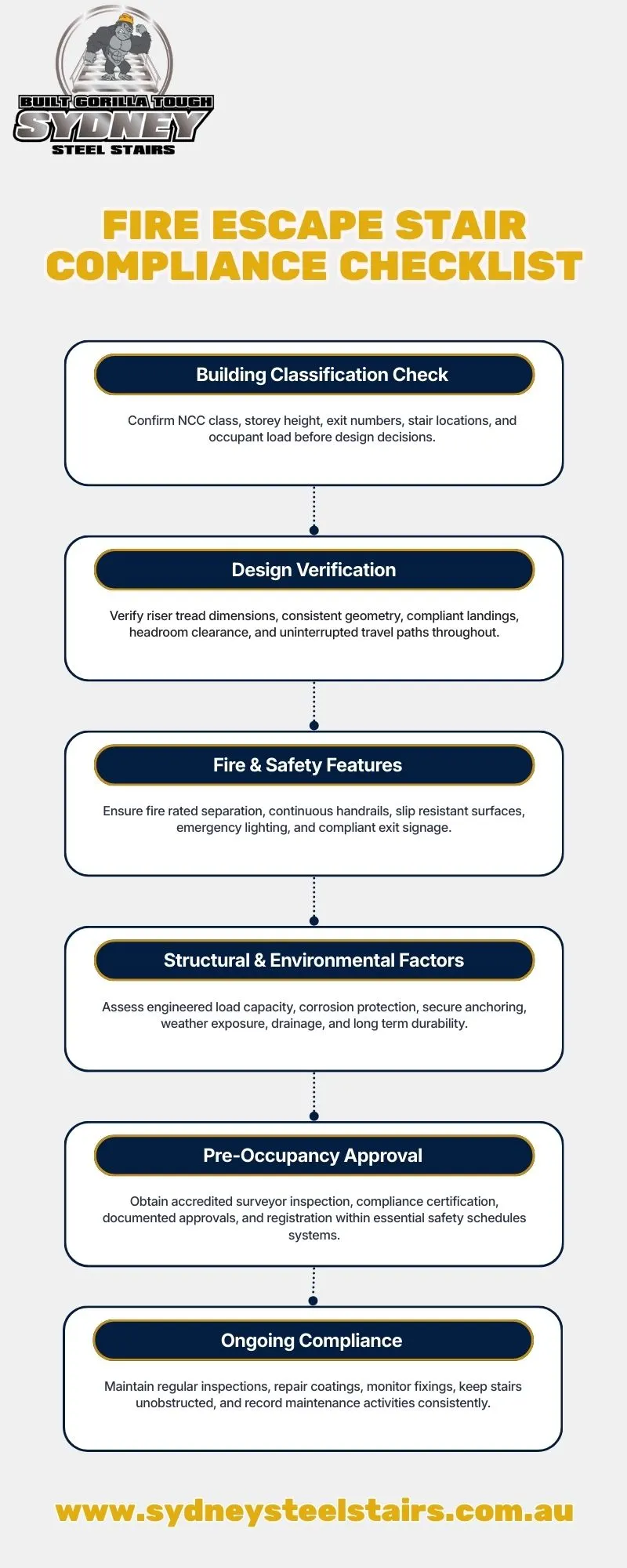
Fire Escape Stair Compliance Checklist
Common Challenges and How to Choose
Common issues include:
- Limited space for retrofitting
- Ongoing corrosion management
- Accessibility compliance requirements
- Integration with existing emergency escape stairs pathways
When selecting commercial fire escape stairs, decision-makers should evaluate:
- Building classification
- Occupant load
- Environmental exposure
- Long-term maintenance budgets
Engaging licensed designers and installers ensures NCC-compliant fire stairs meet both regulatory and operational needs.
Conclusion
Compliant fire escape stairs are a core life-safety system under the NCC. From material selection to installation and maintenance, strict adherence to fire stair regulations in Australia is essential. This guide is based on current NCC provisions, Standards Australia documentation, and regulator guidance. While it provides research-backed insight, final design and compliance verification should always be handled by accredited building surveyors and qualified engineers.
For businesses or property developers in Australia looking for expert solutions, Sydney Steel Stairs offers certified design, installation, and maintenance services for durable, NCC-compliant fire stairs.
Related Article:
Stair Safety Australia 2026: Reduce Falls & Stay Compliant
Staircase Design 2026: Modern Ideas for Australian Homes
FAQs
Can fire escape stairs be adapted for high-rise buildings?
Yes. With a professional assessment, steel fire escape stairs can be safely added to older buildings while meeting NCC rules and ensuring safe exits.
How does corrosion affect the lifespan of exterior fire stairs?
Exposure to weather accelerates wear. Professional installers advise galvanised or powder-coated metal fire escape stairs to extend lifespan and reduce maintenance costs.
Can handrail height and design be customised?
Handrails must comply with NCC dimensions, but within these limits, design and material can be customised for aesthetics, accessibility, and building-specific requirements.
What role do fire stairs play in insurance compliance?
Insurers consider properly installed and maintained NCC-compliant fire stairs a key risk mitigation measure, often affecting premiums and liability coverage.
How often should fire escape stairs be inspected?
The Fire Protection Association Australia recommends regular inspection as part of essential safety measures maintenance programs. Commercial buildings often conduct annual inspections, though local regulations may require more frequent checks.