
Designing compliant stairs in Australia requires more than meeting dimensional requirements. The structural integrity of stair systems depends heavily on how loads are calculated and applied under AS/NZS 1170. This standard defines the actions that structures must safely withstand, making it essential for engineers, architects, and builders involved in stair design.
The challenge is not just understanding the clauses but applying them correctly in real design situations. This guide explains how AS/NZS 1170 applies specifically to stair systems, with a focus on compliance, load behaviour, and practical decision-making.
Where Most Stair Designs Fail Under AS/NZS 1170
Failures in stair design compliance are often linked to incorrect assumptions made during early design stages rather than calculation errors. One common issue is the misapplication of load categories. Stairs are sometimes treated as general floor areas, which leads to inaccurate load assumptions. However, stairs experience concentrated and dynamic loads that differ significantly from flat surfaces.
Another challenge arises when architectural intent does not align with structural validation. Drawings may appear complete, but if load paths are not properly considered, they can fail during certification review.
Breaking Down AS/NZS 1170.1 Through Stair Load Behaviour
AS/NZS 1170.1 defines permanent (dead) loads and imposed (live) loads. In stair systems, both types must be carefully evaluated. Dead loads include the weight of structural components such as stringers, treads, balustrades, and finishes. These loads are generally consistent and predictable. Imposed loads, however, vary depending on usage.
According to Safe Work Australia, these loads must reflect realistic conditions, including foot traffic and potential crowding. Unlike floor systems, stairs distribute loads unevenly. Loads are transferred along inclined elements, creating different stress patterns that must be addressed in structural calculations.
How Stair Systems Actually Transfer Loads in Real Projects
A stair system consists of multiple interconnected components that work together to transfer loads safely. Stringers act as the primary structural members, carrying loads from treads to supports. Treads distribute weight locally, while landings provide transitional load distribution between levels. Understanding how each stair component functions under load is essential before any structural calculation begins.
Point loads are particularly important in stair design. As outlined by WorkSafe Queensland, a single concentrated load on a tread can create higher stress compared to evenly distributed loads. This must be accounted for during structural analysis.
Dynamic loads, caused by movement and repeated use, also influence long-term performance, especially in high-traffic environments.
The Overlooked Link Between Access Stairs and Usage Classification
Stair classification plays a critical role in determining load requirements under AS/NZS 1170. Access stairs, maintenance stairs, and fire stairs are subject to different load expectations. Fire stairs in particular must accommodate higher occupant loads during emergency conditions, which directly affects how structural calculations are approached.
Incorrect classification can lead to underdesign or overdesign. If a stair is used more frequently than initially intended, it may not meet compliance requirements. The Australian Building Codes Board provides guidance through the National Construction Code (NCC), which must align with load assumptions defined in AS/NZS 1170.
Stair Design Australia: Why Local Conditions Change Everything
Environmental factors in Australia significantly influence stair design. External stairs are exposed to wind forces, temperature variations, and corrosion risks. Coastal and industrial environments introduce additional challenges due to moisture and salt exposure.
A study by CSIRO (2022) highlights how environmental conditions impact the durability of steel structures, particularly in high-corrosion zones. Where corrosion risk is significant, galvanized steel finishes offer a practical way to extend service life while maintaining structural integrity. These factors must be considered alongside structural load requirements to ensure long-term performance and compliance.
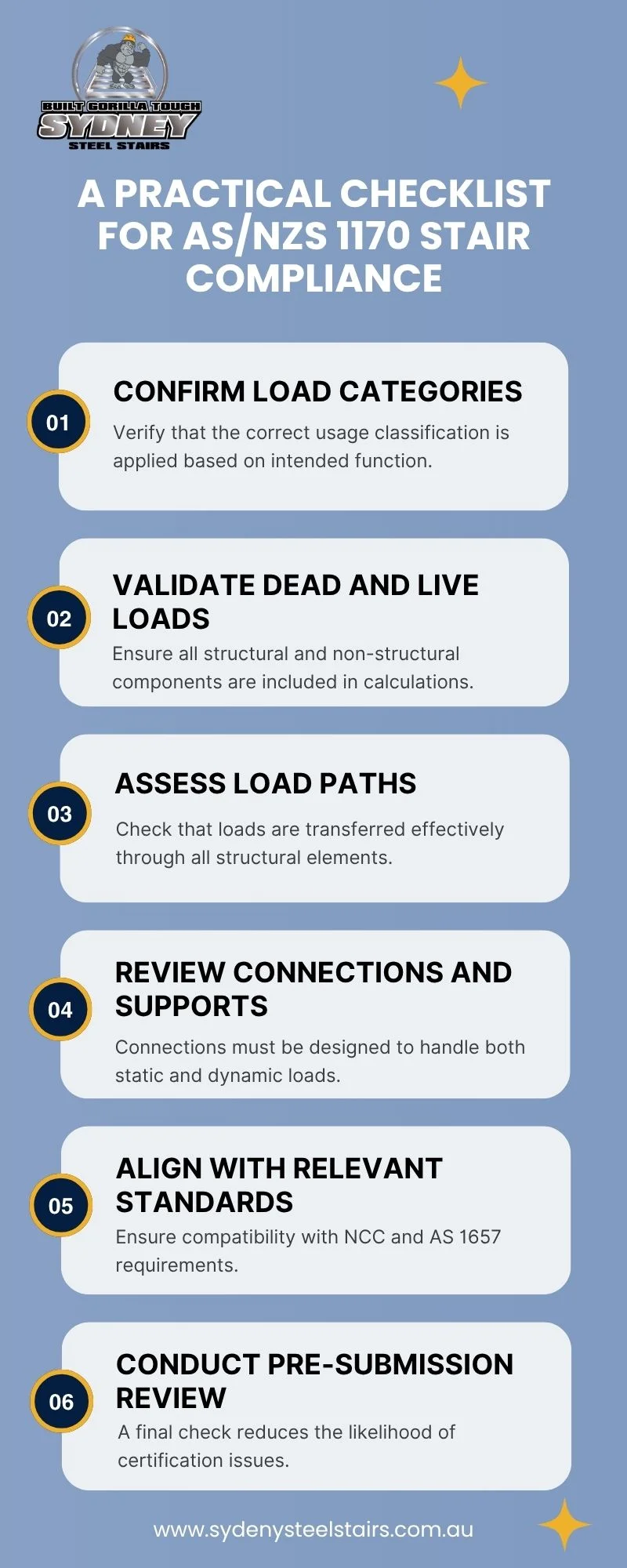
A Practical Checklist for AS/NZS 1170 Stair Compliance
Why “Standard Stairs” Is a Misleading Concept in Compliance Work
The term “standard stairs” can be misleading in a compliance context. Each stair system must be designed based on its specific use, location, and structural requirements. Even similar designs can require different load calculations depending on usage conditions. This is particularly relevant when considering modern staircase design, where aesthetic choices must still be reconciled with the structural demands of AS/NZS 1170.
Prefabricated stairs are not automatically compliant. They must be assessed against project-specific requirements to ensure they meet AS/NZS 1170 standards.
The Cost of Getting AS/NZS 1170 Wrong (Beyond Rework)
Non-compliance can have significant consequences beyond design corrections. Approval delays can disrupt project timelines, especially if a redesign is required. Fabrication errors may lead to material waste and increased costs. A clear understanding of stair safety regulations helps teams anticipate these risks before they reach the certification stage.
From a safety perspective, the Victorian Building Authority notes that incorrect load assumptions can compromise structural performance, increasing long-term risks and liability.
Integrating AS/NZS 1170 with Other Stair Regulations Without Conflict
AS/NZS 1170 must be applied alongside other relevant standards and regulations. The National Construction Code outlines performance requirements, while AS 1657 guides access stairs and platforms.
According to Engineers Australia (2023), aligning structural load standards with design and safety standards is essential to avoid compliance conflicts. A coordinated approach ensures that all requirements are met without duplication or contradiction. This is especially relevant for steel staircase fabrication, where workshop production must reflect the load assumptions established during the design phase.
A Practical Pre-Submission Review Process for Engineers and Builders
A detailed pre-submission review can reduce the risk of approval issues. Start by verifying all load assumptions and ensuring they align with usage classifications. Structural drawings should match calculation outputs to avoid inconsistencies.
Coordination between stakeholders is critical. Misalignment between design and fabrication can lead to compliance failures. Attention should also be given to common certification issues, such as incomplete documentation or unclear load paths.
Conclusion
Applying AS/NZS 1170 effectively requires a balanced approach. Accurate interpretation of load requirements ensures safety while avoiding unnecessary overdesign. Each stair system should be evaluated based on its intended use, environment, and structural configuration. A clear understanding of how loads behave within stair systems allows for efficient, compliant, and practical design outcomes.
For projects that require precise compliance with Australian standards, working with specialists can simplify the process. Sydney Steel Stairs provides stair solutions designed to meet structural requirements, site conditions, and approval expectations without unnecessary complexity.
FAQs
Does AS/NZS 1170 apply to all types of stairs?
Yes, AS/NZS 1170 applies to all stair structures requiring load calculations, including residential, commercial, and industrial stairs, with requirements varying based on usage classification and expected occupancy levels.
What is the difference between AS/NZS 1170.1 and AS 1657?
AS/NZS 1170.1 defines structural load requirements, while AS 1657 provides design and safety guidelines specifically for access stairs, platforms, and walkways, ensuring safe usage and compliance in industrial environments.
How do you determine the correct load category for stairs?
The correct load category is determined by the stair’s intended use, such as residential, commercial, or industrial, ensuring load assumptions align with expected traffic, occupancy levels, and functional requirements.
Are prefabricated stairs automatically compliant with AS/NZS 1170?
No, prefabricated stairs are not automatically compliant. They must be assessed against project-specific load requirements, usage conditions, and environmental factors to ensure they meet AS/NZS 1170 standards.
What is the most common mistake in stair load calculations?
A common mistake is treating stairs like flat floor surfaces, leading to incorrect load distribution assumptions, which can result in underdesign, compliance failures, and potential structural performance issues over time.